
P21 (P021) Peptide Reviewed in Brain Aging Study.
"Several preclinical studies are currently examining neurotrophic factor small-molecule mimetics, such as ciliary neurotrophic factor (CNTF) small-molecule peptide mimetics and peptide 021 (P021). CNTF is part of the IL-6 family of cytokines, and its importance is based on its pivotal role in adult hippocampal and subventricular zone neurogenesis and the differentiation of neural stem cells. Thus, its neuroprotective effects are well established. Regarding its location at the CNS level, CNTF is expressed in astrocytes in neurogenic niches, and its receptor, CNTF receptor α (CNTFRα), is expressed predominantly in neural progenitor cells and hippocampal neurons and many other areas of the brain, including the motor cortex and cerebellum. In addition, preclinical studies using AD transgenic mice have reported that recombinant CNTF can alleviate cognitive impairment and stabilize synaptic protein levels. Furthermore, the ability of P021, a neurogenic and neurotrophic molecule, to enhance dentate gyrus neurogenesis and memory processes has been demonstrated. In the above studies, a triple-transgenic mouse model of AD (3xTg-AD) was utilized, and the results of these studies demonstrated a role for P021 through inhibition of the leukemia inhibitory factor (LIF) signaling pathway and an increase in BDNF expression. Moreover, Kazim et al. demonstrated that oral administration of compound P021 could rescue cognitive aging by enhancing neurogenesis via increased BDNF expression and by decreasing tau levels in aged Fisher rats." (5)CNTF-Induced Neurogenesis is Triggered by Dopamine Receptor Activation.
“Previous reports also showed that the cytokine ciliary neurotrophic factor (CNTF) enhances forebrain neurogenesis in adult mice and is expressed in astrocytes in the subventricular zone. Together, these results suggest a link between dopamine, CNTF, and neurogenesis. Further evidence for this link appeared in a recent issue of The Journal of Neuroscience, in which Yang et al. presented a series of in vivo and in vitro experiments that implicate CNTF as an endogenous regulatory component of dopamine D2-receptor-dependent neurogenesis in the subventricular zone and the dentate gyrus of the hippocampus. Because an imbalance in dopaminergic signaling is a pathological hallmark of several neurological diseases, such as Parkinson's disease, Huntington's disease, and amyotrophic lateral sclerosis, pharmacologically modulating CNTF may be an attractive therapeutic strategy for normalizing dopaminergic and neurogenic deficits.”“Using acute BrdU incorporation to label proliferating neural progenitor cells, Yang et al. demonstrated an increase in cell proliferation within the subventricular and subgranular zones during dopaminergic activation by the selective D2 receptor agonist quinpirole, their Fig. 4 and their Fig. 8. This effect depended on CNTF, because it was abolished in mutant mice lacking CNTF. A CNTF-dependent increase in doublecortin-positive neuroblasts was also observed after quinpirole injection, leading the authors to suggest that dopaminergic activation of CNTF causes an increase in proliferation and neuroblast formation." (4)

Parent Protein (CNTF) of P21 Peptide Rescues Dopamine Neurons.
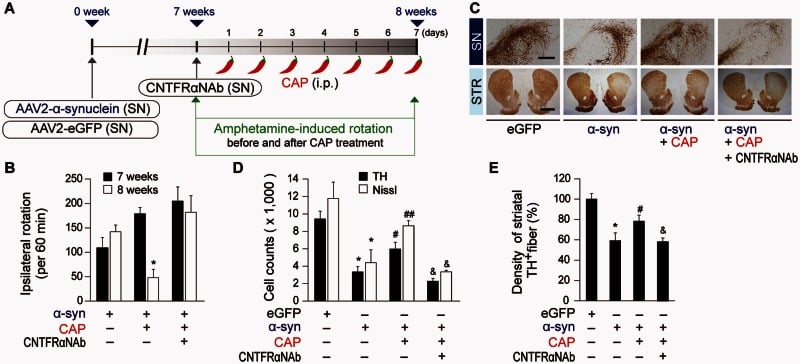
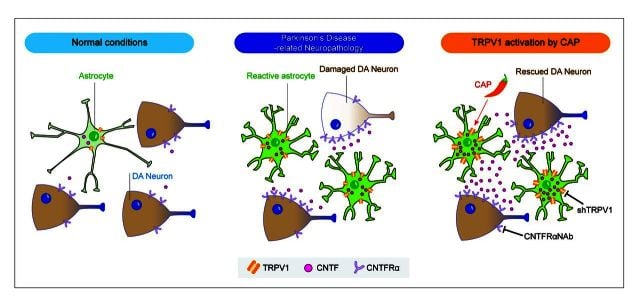
“Ciliary neurotrophic factor (CNTF) has a neuroprotective effect on dopaminergic neurons. Nam et al. report that the capsaicin receptor TRPV1 expressed on astrocytes mediates the production of endogenous CNTF to inhibit degeneration of dopaminergic neurons in two rodent models of Parkinson's disease.”“Currently there is no neuroprotective or neurorestorative therapy for Parkinson’s disease. Here we report that transient receptor potential vanilloid 1 (TRPV1) on astrocytes mediates endogenous production of ciliary neurotrophic factor (CNTF), which prevents the active degeneration of dopamine neurons and leads to behavioral recovery through CNTF receptor alpha (CNTFRα) on nigral dopamine neurons in both the MPP+-lesioned or adeno-associated virus α-synuclein rat models of Parkinson’s disease. Western blot and immunohistochemical analysis of human post-mortem substantia nigra from Parkinson’s disease suggests that this endogenous neuroprotective system (TRPV1 and CNTF on astrocytes, and CNTFRα on dopamine neurons) might have relevance to human Parkinson’s disease. Our results suggest that activation of astrocytic TRPV1 activates endogenous neuroprotective machinery in vivo and that it is a novel therapeutic target for the treatment of Parkinson’s disease.” (1)
“A role for non-neuronal cells such as astrocytes in producing neuropathological or neuroprotective functions in Parkinson’s disease is becoming increasingly recognized.
Astrocytes are the most abundant glial cells in the mammalian brain and they can play both beneficial and detrimental roles in Parkinson’s disease. Astrocytes confer neuroprotection by producing neurotrophic factors such as glial cell line-derived neurotrophic factor (GDNF), mesencephalic astrocyte-derived neurotrophic factor (MANF) and ciliary neurotrophic factor (CNTF).
Transient receptor potential vanilloid 1 (TRPV1), the capsaicin receptor, is involved in pain perception and is highly expressed in sensory neurons. TRPV1 is also present in the brain where it may play a role in modulating neuronal function, controlling motor behavior, and regulating neuroinflammation. The activation of TRPV1 can be achieved by systemic administration of blood–brain barrier-permeable capsaicin. Here we show that capsaicin activation of TRPV1 on astrocytes produces endogenous CNTF in vivo, which prevents degeneration of dopamine neurons by acting through CNTF receptor alpha (CNTFRα) on dopamine neurons in animal models of Parkinson’s disease. This endogenous neuroprotective system (TRPV1 and CNTF on astrocytes, and CNTFRα on dopamine neurons) could be harnessed as a novel beneficial therapeutic target for the treatment of Parkinson’s disease.” (1)
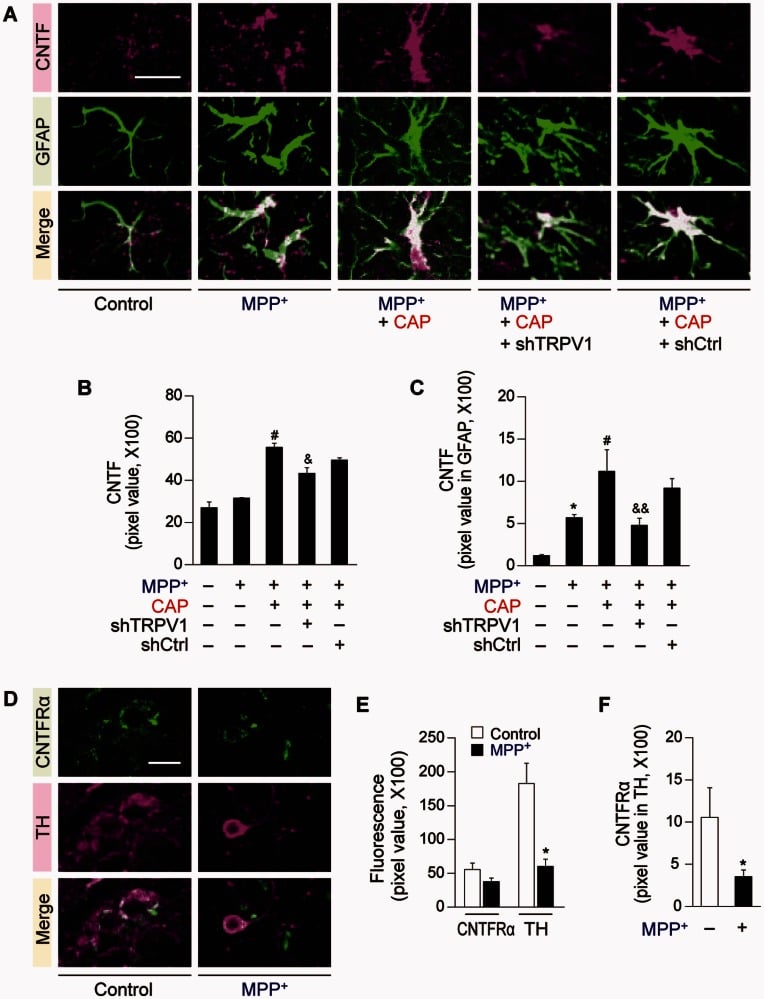
"Many experimental studies demonstrated that TRPV1 activation by capsaicin (CAP) prevents the degeneration of nigrostriatal dopamine neurons in the 1-methyl-4-phenylpyridinium- (MPP+-) or 1-methyl-4-phenyl-1,2,3,6-tetrahydropyridine- (MPTP-) or 6-hydroxy dopamine (6-OHDA-) lesioned rodent model of PD via inhibiting glial-derived inflammatory responses and producing ciliary neurotrophic factor (CNTF). We recently demonstrated that TRPV1 activation by CAP increased the survival of nigral dopamine neurons by modulating the M1/M2 microglia/macrophage phenotype in lipopolysaccharide- (LPS-) injected SN, indicating that TRPV1 is a possible therapeutic target to treat PD." (5)