


Animal study from 1953: glucosamine inhibits cancer
Users of glucosamine supplements usually try to protect or strengthen their joints. Without knowing it, they also protect themselves against cancer. Scientists discovered this in the 1950s.
Study
[TABLE="width: 358, align: right"]
[TR]
[TD="align: right"][/TD]
[/TR]
[/TABLE]
Epidemiological studies show that glucosamine supplementation reduces the risk of lung cancer and colon cancer. According to animal studies, glucosamine activates suicide enzymes that try to prevent cancer cells from posing a danger to an organism.In 1953 Canadian researchers affiliated with Montreal General Hospital published an animal study in which they injected mice with sarcoma cells. Sarcoma is a malignant tumor in supporting tissues such as bones, muscles, body fat, nerves, blood vessels and connective tissue.
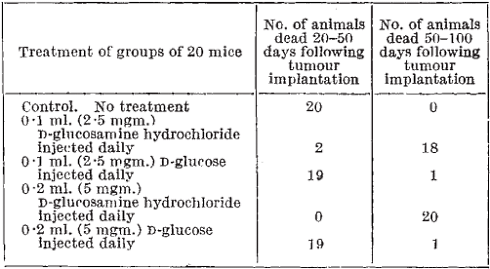
The researchers then gave some of the mice daily injections of glucosamine in their small intestine. If the mice had been adult humans simply taking oral glucosamine supplements, they would have taken about 1600-3200 milligrams of glucosamine daily.
Another part of the mice received injections with glucose. This was the control group.
Results
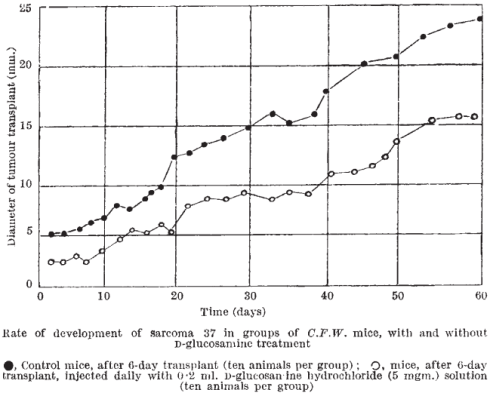
The supplement did not prevent the mice from dying, but it did extend the time the animals could still live. Glucosamine inhibited the growth of the tumors.

Side effects did not occur.
Mechanism
Based on previously published studies, the Canadians suspect that glucosamine competes with glucose in the cell. This is not a problem for healthy cells, but it is for rapidly dividing cancer cells which need a lot of energy.
Conclusion
"The survival-rate of tumour-bearing mice treated with D-glucosamine is considerably greater than that of untreated animals, and gives rise to the hope that D-glucosamine (or its derivatives) may represent a substance with distinct chemotherapeutic possibilities", write the Canadians.
More coming soon.
Source:
Nature. 1953 Feb 7;171(4345):252-4.
Users of glucosamine supplements usually try to protect or strengthen their joints. Without knowing it, they also protect themselves against cancer. Scientists discovered this in the 1950s.
Study
[TABLE="width: 358, align: right"]
[TR]
[TD="align: right"][/TD]
[/TR]
[/TABLE]
Epidemiological studies show that glucosamine supplementation reduces the risk of lung cancer and colon cancer. According to animal studies, glucosamine activates suicide enzymes that try to prevent cancer cells from posing a danger to an organism.In 1953 Canadian researchers affiliated with Montreal General Hospital published an animal study in which they injected mice with sarcoma cells. Sarcoma is a malignant tumor in supporting tissues such as bones, muscles, body fat, nerves, blood vessels and connective tissue.
The researchers then gave some of the mice daily injections of glucosamine in their small intestine. If the mice had been adult humans simply taking oral glucosamine supplements, they would have taken about 1600-3200 milligrams of glucosamine daily.
Another part of the mice received injections with glucose. This was the control group.
Results
The supplement did not prevent the mice from dying, but it did extend the time the animals could still live. Glucosamine inhibited the growth of the tumors.
Side effects did not occur.
Mechanism
Based on previously published studies, the Canadians suspect that glucosamine competes with glucose in the cell. This is not a problem for healthy cells, but it is for rapidly dividing cancer cells which need a lot of energy.
Conclusion
"The survival-rate of tumour-bearing mice treated with D-glucosamine is considerably greater than that of untreated animals, and gives rise to the hope that D-glucosamine (or its derivatives) may represent a substance with distinct chemotherapeutic possibilities", write the Canadians.
More coming soon.
Source:
Nature. 1953 Feb 7;171(4345):252-4.
