• Hello, this board in now turned off and no new posting.
    Please REGISTER at Anabolic Steroid Forums, and become a member of our NEW community!

Terrorists Attack Mumbai! Over 100 dead, Hundreds Injured

min0 lee

Senior Member
Elite Member
Joined
Oct 9, 2004
Messages
14,803
Reaction score
1,587
Points
113
Age
60
Location
The Bronx, NYC
2i8xguo.jpg


Gunmen attack hotels, train station in deadly Mumbai wave of terror

BY HELEN KENNEDY
DAILY NEWS STAFF WRITER

Updated Thursday, November 27th 2008, 2:48 AM

Terrorists took over Mumbai Wednesday, attacking up to a dozen locations, killing at least 101 people and spreading chaos across the rich island city dubbed the "New York of India."

Foreign tourists were taken hostage at three five-star hotels by terrorists so young witnesses took them for boys.

"The whole city is being held hostage," terrorism expert Sajjan Gohel told CNN after talking to friends who were huddled inside one of the hotels.

The terrorists stalked luxurious lobbies and banquet halls looking for anyone with an American or British passport.

Outside, cops and machine gun-toting terrorists waged pitched battles in the streets of the former Bombay, the world's fifth-largest metropolis.

Two gunmen in a stolen police van drove around shooting randomly at pedestrians and flinging grenades.

At one point, the upper floors of the Taj Mahal Palace, a 1903 landmark and one of the world's most famous hotels, were engulfed in flames as hostages were still being held inside.

Screams and gunfire could be heard from inside.

As dawn broke, police with loudspeakers called for a curfew around the hotel and ambulances pulled up to its ornate entrance.

NDTV quoted a witness who saw a Taj stairwell "full of dead bodies."

Officials said they killed four gunmen and arrested nine. An unknown number of others were still at large.

A little-known group calling itself Deccan Mujahideen claimed responsibility.

On Sept. 15, a group called the Indian Mujahedeen e-mailed a threat of attacks on Mumbai to retaliate for the city's police harassing Muslims.

The attacks came one day after Interpol reportedly arrested Rahil Sheikh, a mastermind of the Mumbai subway bombings carried out by the Student Islamic Movement of India that killed 187 people in July 2006.

A man who identified himself as Sahadullah told India TV he was among seven militants holding hostages inside the luxury Oberoi Hotel.

"We want all mujahedeens held in India released and only after that we will release the people. Release all the mujahedeens, and Muslims living in India should not be troubled," he said.

Wednesday's coordinated attacks began at 9:30 p.m. local time - 11:30 a.m. in New York.

Terrorists opened fire at random with AK-47s and grenades inside the city's central train station, at three luxury hotels, at Leopold Caf??© - the city's most famous tourist hangout - and at a children's hospital, among other places.

"Bodies starting falling down. I saw people crying, in pain. Bullets. Bloodshed. Everything," said one shell-shocked witness who saw masked gunmen open fire in the Taj lobby.

"At least six foreigners have been killed and the death figure has gone up to 101 now," Ramesh Tayde, a senior police officer, told Reuters from Mumbai's control room, adding that 287 people were injured.

The city's most famous cop, crusading "encounter specialist" Vijay Salaskar, was killed in a gunfight. So was Hemant Karkare, the high-profile head of the anti-terror unit.

Condemnation and offers of help poured in from everywhere.

"We stand with the people of India, whose democracy will prove far more resilient than the hateful ideology that led to these attacks," President-elect Barack Obama said in a statement.

The first shots appear to have been fired at Chhatrapati Shivaji Terminus Station, the city's Grand Central, where many bodies were littered.

Gunmen sprayed bullets in the main concourse. After panicked straphangers fled, leaving behind the dead, two gunmen reportedly took a position on a train and staged a gun battle with police commandos.

Among those trapped in the Taj hotel were captains of industry and three members of Parliament who had been dining in the hotel's swanky restaurant.

Businessman Rakesh Patel told Indian TV he and a friend were captured - but escaped.

"We were having dinner when two young boys came to the restaurant. They took us up to the 18th floor. I think they were trying to get to the roof. Me and my friend escaped down the fire exit," he said.

"They were very young, like boys really, wearing jeans and T-shirts," said Patel, his face smudged with smoke.

Briton Sajjad Karim, 38, a member of the European Parliament, spoke to Sky News by cell phone from a barricaded basement room in the Taj, where a large number of guests were hiding.

He described terrorists opening fire at random in the gracious lobby.

"Some of us split one way and some another. A gunman just stood there spraying bullets around, right next to me.

"I saw a number of people go down, but I was fortunate enough to get away," he said. "I ran into the hotel kitchen... We are now in the dark in this room and we have barricaded all the doors. It's really bad."

Then his phone died.

The nearby Oberoi hotel was evacuated after a huge explosion set fire to the building.

Soldiers could be seen escorting chambermaids, children and executives out of the hotel. Injured guests were rushed out on makeshift stretchers: shiny brass hotel luggage carts.

British businessman Alex Chamberlain told Sky News he escaped from his captors at the Oberoi by posing as a foreigner.

"They told everybody to stop and put their hands up and asked if there were any British or Americans. My friend said to me, 'Don't be a hero; don't say you are British,'" he said.

At the Trident hotel, explosions could be heard for several hours after the initial attack.

Businessman Alan Jones told the BBC of his elevator doors opening onto the lobby slaughter.

"We heard bangs as the door opened," he said. "A Japanese man, one of four men in the lift, was shot and wounded at that precise moment. I frantically pressed the 'close door' button but had to move the shot man's foot for the doors to close."

hkennedy@nydailynews.com
 
Mumbai terror spree the work of only 10 Islamic militants

BY LARRY MCSHANE
DAILY NEWS STAFF WRITER

Sunday, November 30th 2008, 4:00 AM

The 60-hour Mumbai terror spree that killed at least 174 people was the brutal handiwork of just 10 Islamic militants who wanted to create a 9/11-caliber catastrophe, officials said Saturday.

The well-armed, well-trained compact crew ran amok through India's financial capital for three days, shooting up its largest train station, torching luxury hotels and turning a local Jewish center into a tomb.

They held India's highly trained Black Cat commando units at bay while orchestrating the coordinated carnage - with strikes in 10 different locations during its first two hours.

Nine of the terrorists were finally killed, the last three during a gunfight inside the landmark Taj Mahal hotel - an unlikely home for the militants' last stand.

The 105-year-old luxury hotel was damaged by fire and explosions, while the terrorists left bodies, some with grenades stuffed in their mouths, scattered through blood-spattered hallways and hotel rooms.

The hotel received a terror warning and heightened security, but then relaxed it just before the attacks, according to the chairman of the group that owns the hotel.

"It's ironic that we did have such a warning and we did have some measures," Ratan Tata of the Tata Group told CNN on Saturday. He added the terrorists "knew what they were doing" and used the less-secure back entrance.

The lone surviving militant, grilled by Indian interrogators, said the attackers wanted to create a Mumbai version of the World Trade Center attacks, according to Times Now TV.

The terrorists communicated via mobile and satellite phones and employed GPS technology during their rampage, Indian officials said.

As tensions mounted over which terrorist group was responsible for the attacks, India's Prime Minister Manmohan Singh called a rare meeting of leaders from the country's main political parties to discuss the situation today.

The death toll was expected to rise as more areas are searched, and nearly 240 people were wounded.

Brooklyn-raised Rabbi Gavriel Holtzberg, 29, and his wife, Rivkah, 28, were found dead inside the Chabad-Lubavitch center along with Rabbi Leibish Teitelbaum, a former New Yorker who lives in Jerusalem.

Shaky survivors spun tales of horror as a semblance of sanity returned after three days of insane violence that brought the city to its knees.

"It felt like a war zone, like I was in Iraq or Afghanistan, and it went on for two nights and one full day," said Geeta Kapur, who cowered inside a 33rd-floor hotel room at the five-star Oberoi.

Authorities were investigating whether the terrorists used a hijacked Indian trawler to reach the seaside city. A bound corpse was discovered aboard the abandoned trawler Kuber, officials said Saturday.

The terrorists possibly used a black-and-yellow rubber dinghy to make land after ditching the trawler. The raft was discovered near the scene of the initial attack, authorities said.

President Bush, after speaking with American diplomats in India, said U.S. authorities were keeping a close watch on the volatile situation. "We pledge the full support of the United States as India investigates these attacks, brings the guilty to justice and sustains its democratic way of life," Bush said.

Mumbai clothing-store owner Suresh Thakkar, 59, said the city would emerge from its darkest hours. "What happened is disgusting," he said. "It will be harder to recover, but we will recover."

lmcshane@nydailynews.com

With Oren Yaniv and News Wire Services
 
Pros deride terrible tactics and poor equipment in face of Mumbai crisis

BY JAMES GORDON MEEK
DAILY NEWS WASHINGTON BUREAU

Friday, November 28th 2008, 9:04 PM

WASHINGTON - Indian officials defended their response to the Mumbai massacre Friday as the world watched them struggle through what some U.S. experts considered a Munich moment.

"Our operations had to be deliberate and slow because the life of the hostages and innocent residents in the [Taj Mahal] hotel was of great importance to us," Indian Army Lt. Gen. N. Thamburaj said. "I have especially told the commandos who are taking part not to rush things."

But just as German officials blew the 1972 Olympics hostage crisis by Palestinian terrorists, Indian commandos failed to stem some of this week's terror.

One U.S. counterterror official said the Indians looked clownish compared to commandos of the British Special Air Service.

"This wasn't the SAS digging knuckleheads out of some embassy," the chagrined official said.

Hesitating may have cost lives at places like the Mumbai Jewish community center, experts said.

"It's just like Columbine," insisted former FBI Hostage Rescue Team leader Danny Coulson, referring to the 1999 Colorado high school massacre. "If they're slaughtering people, you've got to go in."

Grenades were still blowing out windows at the Taj on live TV 48 hours after the horror began.

Indian authorities "were caught completely unaware," said Vince Cannistraro, a retired CIA counterterror chief.

Supposedly elite commandos appeared to be lacking standard tools: tear gas and masks, laser-sighted guns and stun grenades.

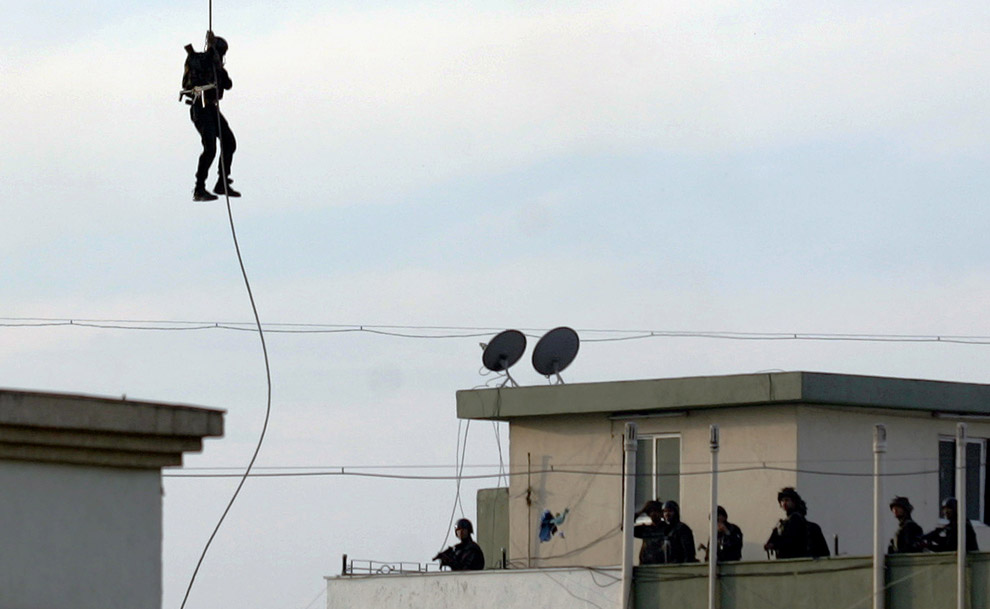
They also ineptly rapelled from choppers to rooftops and raised machine guns over their heads to indiscriminately fire into windows at terrorists.

"I find it hard to justify that kind of shooting," said Chris Voss, a former FBI lead international hostage negotiator.

jmeek@nydailynews.com
 
Indian security chief resigns over Mumbai attacks

Sun Nov 30, 2008 6:20pm EST
By Rina Chandran

MUMBAI (Reuters) - The fallout from a three-day rampage that killed nearly 200 people in Mumbai threatened on Sunday to unravel India's improving ties with Pakistan and prompted the resignation of India's security minister.

New Delhi said it was raising security to a "war level" and had no doubt of a Pakistani link to the attacks, which unleashed anger at home over the intelligence failure and the delayed response to the violence that paralyzed India's financial capital.

Officials in Islamabad have warned any escalation would force it to divert troops to the Indian border and away from a U.S.-led anti-militant campaign on the Afghan frontier.

Newspaper commentaries blasted politicians for failing to prevent the attacks and for taking advantage of its fallout before voting in Delhi on Saturday and national polls due by May.

Indian Prime Minister Manmohan Singh said he would boost and overhaul the nation's counterterrorism capabilities, an announcement which came after Federal Home Minister Shivraj Patil resigned over the attacks.

"We share the hurt of the people and their sense of anger and outrage," Singh said. "Several measures are already in place ... But clearly much more needs to be done and we are determined to take all necessary measures to overhaul the system," he said.

Air and sea security would be increased, and India's main counter-terrorist National Security Guard would be increased in size and given more regional bases, he said in a statement.

Singh also named Finance Minister Palaniappan Chidambaram -- much derided as finance minister but respected for his work overhauling India's security agencies as a junior minister in the 1990s -- to take over Patil's job.

Singh, an economist by training, will take over the finance portfolio for now, the government said.

Analysts said they expect India's financial markets to get a boost from the personnel changes.

"Markets will rejoice," Arum Kejriwal, a strategist at research firm Kris, said of Chidambaram and Patil. "People will accept that the government has removed two non-performers and this can positively influence the markets."

Indian stocks closed up marginally after markets opened on Friday, the first time since the attacks, while the rupee fell. But analysts said it had already been under pressure.

Indian officials have said most, if not all, of the 10 Islamist attackers who held Mumbai hostage came from Pakistan.

The tension between the nuclear rivals has raised the prospect of a breakdown of peace efforts going on since 2004. The two nations have fought three wars since 1947, when Muslim Pakistan was carved out of Hindu-majority India.

They went to the brink of a fourth conflict after a 2001 militant attack on the Indian parliament which New Delhi also blamed on Pakistan.

"We will increase security and strengthen it at a war level like we have never done it before," Sriprakash Jaiswal, India's minister of state for home affairs, told Reuters on Sunday.

"They can say what they want, but we have no doubt that the terrorists had come from Pakistan," Jaiswal said.

An official in Islamabad said the next one to two days would be crucial for relations. Pakistan has condemned the assaults and denied any involvement by state agencies.

MOPPING THE BLOOD

The three-day rampage and siege in Mumbai turned India's financial and entertainment hub into a televised war zone.

On Sunday, the smell of disinfectant was strong outside Cafe Leopold, and the sidewalk wet from mopping -- a different sight from Wednesday night, when blood-splattered shoes and napkins lay strewn among broken furniture and glass.

It opened briefly before police came and shut it down again, saying investigations needed to be completed first.

Elsewhere in the trendy Colaba district where the fighting took place, shops were open and traffic flowed despite police barricades and heavy clean-up work around the Taj Mahal hotel, a 105-year-old landmark and site of the longest siege.

Broken windows were boarded up and firemen used a crane to reach the sixth floor, gutted by a fire set by the militants as they fought dozens of commandos in the corridors.

Elite Black Cat commandos killed the last of the gunmen on Saturday after three days of room-to-room battling inside the Taj, one of several landmarks struck in coordinated attacks on Wednesday night.

Hundreds of people, many of them Westerners, were trapped or taken hostage as the gunmen hurled grenades and fired indiscriminately. At least 22 of those killed were foreigners, including businessmen and tourists.

Nine gunmen and 20 police and soldiers were also killed. A tenth militant was caught alive.

On Saturday, India's navy and coast guard boosted coastal patrols, after evidence mounted that the attackers had come by boat to Mumbai from Karachi, Pakistan's main port.

India's Home Ministry said the official toll in Mumbai was 183 killed. Earlier, Mumbai disaster authorities said at least 195 people had been killed and 295 wounded.
 
Mumbai attacks: surviving attacker 'sold' to terrorists by father
The captured terrorist in the Mumbai (formerly Bombay) attacks, Azam Amir Qasab, has told interrogators that his father forced him to join Lashkar-e-Taibat (LeT) so that the family could earn more money.

By Damien McElroy in Mumbai
Last Updated: 5:08PM GMT 02 Dec 2008

Qusab's father Amir, a carpenter in the Pakistani town of Faridkot, made initial contact with the leading LeT commander Zakiur Rehman who promised the family a ??£2,000 payment, according to the Daily News and Analysis newspaper.

Rehman was known to Qusab as Chacha, or uncle.
The 21 year old who was captured after a mob set on him after he took part in a killing spree at Mumbai's main train station on Wednesday had been involved in minor crimes before his recruitment.

After teaming up with Rehman, he was recruited for the Mumbai mission. Rehman was reported to have personally delivered the main orders for the 10-man group.

"Around 45 days before the terror strike Chacha called the ten and briefed them about the mission," an official told the newspaper.
Meanwhile, it has been revealed that the Mumbai terrorists who battled Indian commandos for 60-hours last week relied on cocaine and other stimulants to stay awake for the duration of the fight.

Officials said drug paraphernalia, including syringes, was recovered from the scene of the attacks, which killed almost 200 people.
The heavily built men, who had undergone training at a special marine camp established by the Lashkar-e-Taibat (LeT) terrorist group in Pakistan, had also used steroids to build a tougher physique.

"We found injections containing traces of cocaine and LSD left behind by the terrorists and later found drugs in their blood," said one official.

"There was also evidence of steroids, which isn't uncommon in terrorists.
"These men were all toned, suggesting they had been doing some heavy training for the attacks. This explains why they managed to battle the commandos for over 50 hours with no food or sleep."
One terrorist used the drugs to keep on fighting despite suffering a life-threatening injury
 
Back
Top