

Preface: The idea for this article was sparked last year when James and I presented together in the UK at the Personal Trainer Collective Conference along with Brad Schoenfeld and Alan Aragon. At that time, I had done a ton of research on the genetic differences pertaining to fitness outcomes, but I hadn’t yet seen a lot of data reporting individual differences. James’ presentation was filled with graphs depicting the stark differences in individual results, and it dawned on me that this is probably the most important aspect of science that fails to be reported. We hope that in time it becomes standard practice to report individual data, but in the meantime, we wish to impress upon you that research typically only reports means, which may or may not apply to you.
Consider the following scenarios:
· Your friend swears by high intensity interval training (HIIT) for losing body fat. In addition to increased caloric expenditure from the session, she notices a boost in overall energy throughout the day, which she claims helps her burn even more calories. Yet every time you employ HIIT, you notice that the scale doesn’t move. Moreover, it seems to just make you tired and exhausted, which prevents you from achieving stellar strength training workouts in the gym, thereby sabotaging your efforts to build strength and muscle.
· You read an article saying that deep squats are the absolute best thing you can do to build your legs and hips. But every time you perform them, your hips and low back are beat to smithereens and you can’t train legs again for another 10 days. The persistent pain you experience prevents you from using your muscles to their fullest potential.
· Your training partner says steady-state cardio makes her hungry. She notes that she has a harder time adhering to her diet when she does cardio compared to when she omits it altogether. You, on the other hand, consistently lose your appetite after a cardio bout. Cardio therefore seems to help you create an even greater energy deficit.
· At the gym, you overhear a bro bragging that all he has to do to build his pecs is a few sets of push-ups close to failure each week and he grows like crazy. You can’t seem to get anywhere unless you’re doing 15-20 sets of various pec exercises per week, though. He claims that your workout is overkill and creates too much damage and soreness, but you recover just fine from your routine.
How can we know who is right? Maybe everyone is.
Often we like to turn to research to tell us how to structure our diet and training programs, and studies certainly can act as guidelines or starting points. We must remember, however, that in general, research reports averages. Individual responses to exercise and diet can vary dramatically from one person to the next; averages don’t provide us with this information.
In this article, we’re going to delve into some critically important yet seldom discussed considerations in evidence-based fitness programming.
· Appetite and food intake
· Daily energy levels and non-exercise activity
· Sleep quantity and quality
· Resistance training focus (i.e., Does it interfere with your ability to train progressively and set personal records?)
· Willpower throughout the rest of your day (i.e., Do you lose discipline in other components of your training and diet?)
Let’s take a closer look at some of these elements.
The following graph shows the variation in compensatory eating from one subject to the next. The solid line indicates where calorie intake was equal for the exercise and no-exercise conditions, meaning there was no compensation at all (i.e., the subjects did not eat food to make up for the calories burned in the exercise session). The dashed line indicates where the subjects perfectly compensated for the calories burned during exercise (e.g., if they burned 100 calories, they ate 100 calories). Thus, subjects between the solid and dashed line showed only some compensation (e.g., burning 100 calories but eating 50), while subjects at or above the dashed line showed perfect or overcompensation (meaning they ate more than they burned in the exercise session).
How does this apply to you? Are you a person who feels extremely hungry after low-intensity cardio? Then perhaps it’s not for you. Or maybe you’re a person who doesn’t get hungry, or even loses appetite, in response to low-intensity cardio. If that’s the case, low-intensity cardio might be a good way to help you establish an energy deficit to lose fat.
It’s been shown HERE that people who tend to compensate for exercise by eating more are people who have a preference for high-fat, sweet foods; these individuals have a very high hedonic, or pleasure, response to these foods. So, if you’re a person who really loves cake, ice cream, and so on, and tend to have a weakness for these foods, then low-intensity cardio might stimulate your appetite. In your case, then, you can try things like interval training (some research suggests it may suppress appetite, although the data is not consistent), or skip cardio altogether.
The researchers had 34 women engage in a 13-week brisk walking program. Some women experienced an increase in physical activity energy expenditure, yet others experienced a decrease! How could this be? It’s because some of the women compensated for the exercise by decreasing their NEAT levels. Perhaps the exercise made them tired, or maybe they thought that, since they exercised that day, they were free to sit around the rest of the day. Whatever the reason, each subject responded differently to the exercise program in terms of NEAT levels.
Below is a chart showing the differences in physical activity energy expenditure between the women who didn’t reduce NEAT and the women who did.
How does this apply to you? Do you feel so exhausted after a cardio session that you sit around the rest of the day? If that’s the case, the cardio may be doing you more harm than good because it’s reducing your NEAT. But if you feel energized and active, then the cardio is likely an effective fat loss tool for you. Again, it’s how you respond individually, something the research can’t always tell you.
How does this apply to you? If you find that cardio seems to improve your sleep, then you should indeed consider regularly performing cardio, especially considering that sleep and muscle mass are positively related according to THIS study. However, if you instead find that cardio interferes with your sleep, then you should consider omitting it altogether, especially given that diminished sleep duration and quality are linked to obesity, insulin resistance, type 2 diabetes, metabolic syndrome, cardiovascular disease, and mortality (see HERE).
But this subsection isn’t about the interference effect per se. What we want you to consider is whether or not you tend to give your resistance training your all if you did cardio that morning or if you know you have to do cardio later in the evening. Consistently gaining strength and setting PRs is very challenging. It requires tremendous focus, grit, and determination. One study showed that challenging cognitive tasks impaired subsequent push-up and sit-up performance (see HERE). Sure, cardio isn’t a mental task, but THIS paper suggests that anything and everything can impact physical performance. Sometimes cardio can distract you from making meaningful strength gains in the gym, and the weight room is better suited than cardio at helping you transform your physique.
How does this apply to you? If you’ve noticed that cardio negatively affects your strength training performance, you could try lower intensity cardio such as brisk walking, making sure to spread the sessions out as much as possible during the day. You could alternatively omit cardio altogether and save your physical and mental energy for the gym. But if you find that cardio doesn’t impact your ability to focus on your strength training sessions, then by all means, feel free to employ some cardio. After all, most pro bodybuilders do cardio and it’s obviously not hampering their gains.
For example, exerting self-control causes people to consume more food, but there are many factors that appear to influence the relationship between ego depletion and food intake, including BMI (see HERE), confidence surrounding one’s ability to regulate weight (see HERE), and impulsivity (see HERE). Furthermore, some individuals are much more sensitive to the effects of ego depletion than others, according to THIS study.
How does this apply to you? Let’s say that you’re a morning person, you enjoy running in general, you love being outside, you have a nice running trail that starts a block away from your house, and working up a nice sweat before your work day starts makes you feel confident and productive. In this case, you seem like a good candidate for cardio. On the other hand, let’s say you cringe every single morning at the thought of performing your cardio (there’s a strong genetic component to enjoying exercise according to THIS, THIS, and THIS paper), you have to drive 40 minutes to get to your gym where you do your cardio, and you loathe driving in rush hour traffic. In this case, it is very likely that stubbornly sticking to your morning cardio regimen would deplete your self-control and cause you to exert less willpower later in the day. This could result in greater caloric consumption and possibly greater indulgence of junk foods, which would sabotage your attempts to become leaner and healthier. If the latter scenario describes you, it is likely that you’ll see better results by omitting cardio altogether. Sometimes simpler is better.
 The bar on the far right shows the average increase in muscle, which is around 5%. But look at the tremendous variation between individuals. The changes ranged from a -2.5% to a nearly 20% change in muscle size. While most people experienced an increase, five of the subjects actually lost muscle. Interestingly, genetic predispositions to hypertrophy are muscle-specific, meaning that you can likely grow certain muscles quite easily while others seemingly refuse to grow (see HERE). This is evident when you consider THIS study which examined 45 men and found that one man had 484% (almost 5X) more glute volume than another man.
Changes in strength also show marked variation from one person to the next. Check out the individual results of THIS study which examined concurrent training, that is, training strength and endurance at the same time.
These dramatic patterns of strength and hypertrophy responses are very predictable in the literature as they have been replicated in numerous studies. Some folks can gain strength or muscle quite easily while others cannot (see HERE). Interestingly, however, those who gain the most strength aren’t always the same individuals who gain the most muscle and vice versa. There’s a large genetic component to this phenomenon, and we know that muscle growth has much to do with how your satellite cell system functions and how much growth factors you produce (see HERE). Hell, according to THIS study, testosterone levels of male Olympic athletes range from 58 ng/dL to 1154 ng/dL (average is 420 ng/dL), and in females the range is from 0 ng/dL to 923 ng/dL (average is 78 ng/dL).
For example, let’s say you are designing your resistance training program. You need to think about how you respond as an individual to factors such as:
· Volume
· Frequency
· Load
· Effort
· Exercise selection
Consider volume, for example. THIS very recent meta-analysis on volume and hypertrophy indicated that, for optimal hypertrophy, you should do 10 or more sets per muscle group per week. However, once again, this is based on averages. For example, 15 weekly sets might work great for your training partner, but you find that anything more than 8 and you get nothing but sore joints. The type of exercise also matters; 10 weekly sets of leg extensions is not the same as 10 weekly sets of squats. Moreover, due to genetic variation, some individuals gain more lower body strength with a single set compared to multiple sets (see HERE).
Think of the hip joint. Many popular knee dominant exercises necessitate sound levels of hip flexion mobility in order to carry out properly. For example, the deep squat, leg press, high step up, and pistol squat each appear to involve at least 120 degrees of hip flexion at the bottom of the movement. Once your hips run out of range of motion, if you continue going deeper, you can only do so by posteriorly tilting your pelvis and flexing your lumbar spine (this is commonly known as “butt wink”). While some butt wink is acceptable, too much is dangerous and likely to lead to hip and low back issues.
Take a look at the table below from THIS study.
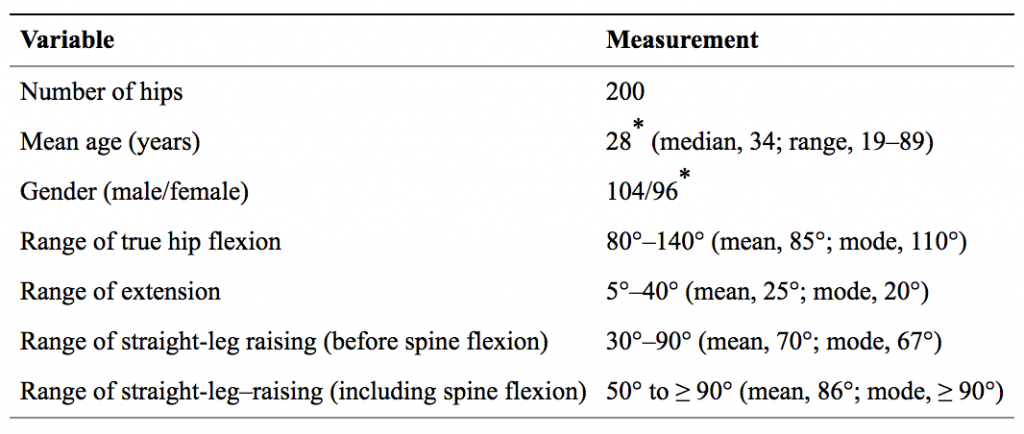 The researchers examined the hip flexion mobility of 200 subjects. There was a 60 degree difference in mobility between the least and most flexible individuals. The least flexible person could only attain 80 degrees of hip flexion, whereas the most flexible person could reach 140 degrees. The former person couldn’t even squat to parallel without butt winking, whereas the latter individual could squat rock bottom with no problems.
How does this apply to you? If you have good mobility, then you can likely perform most exercises with textbook mechanics, which is excellent because greater range of motion is typically shown in the research to lead to superior hypertrophic outcomes. However, if you possess grossly inferior mobility, then you will likely get beat up from exercises that take those joints into a deep stretch. In addition to the aforementioned exercises, this could apply to dips, dumbbell bench press, push ups off of handles, flies, stiff leg deadlifts, good mornings, and more.
While it is obvious that these exercises can easily be modified in order to suit an individual’s anatomy (just go as deep as your body comfortably allows), most people who are lacking in mobility tend to go deeper than they should in an attempt to make their range of motion appear more normal, and this leads to problems at the shoulders, hips, and low back. If this accumulates and leads to nagging pain, it will prevent you from achieving optimal hypertrophy since pain inhibits muscle activation.
How does this apply to you? Some people can bust out 5 sets of squats, deadlifts, and lunges and feel fine the following day, while others are crippled for several days following the same workout. If you’re the type that doesn’t get overly sore and recovers quickly, then you can train with more volume and frequency than others and you don’t have to give much thought to exercise selection. However, if you experience tremendous soreness from common workouts and seem to take forever to recover, then you can either 1) train less frequently (not ideal in our opinion), 2) train with less volume, 3) train with less effort, and/or 4) select exercises that don’t create as much soreness (exercises that stress the stretch position such as stiff-legged deadlifts and lunges create more damage than exercises that stress the contracted position such as back extensions and hip thrusts).
The best fat loss program for you may involve cardio – or it may not. The best strength training program for you may involve deadlifts – or it may not. The best hypertrophy program for you may involve training each muscle group 3 days per week – or it may not. Moreover, what is best for you now may not be best for you next month, or next year, or in the next decade.
There are so many variables to consider, and science is only just beginning to examine how individuals respond to these variables. There are strong genetic components to practically every single variable that impacts your ability to gain muscle, lose fat, increase strength, and improve athleticism. You must therefore utilize the scientific method and experiment in order to figure out what works best for you.
The research can guide you on where to start, but only you can determine where you finish.
Consider the following scenarios:
· Your friend swears by high intensity interval training (HIIT) for losing body fat. In addition to increased caloric expenditure from the session, she notices a boost in overall energy throughout the day, which she claims helps her burn even more calories. Yet every time you employ HIIT, you notice that the scale doesn’t move. Moreover, it seems to just make you tired and exhausted, which prevents you from achieving stellar strength training workouts in the gym, thereby sabotaging your efforts to build strength and muscle.
· You read an article saying that deep squats are the absolute best thing you can do to build your legs and hips. But every time you perform them, your hips and low back are beat to smithereens and you can’t train legs again for another 10 days. The persistent pain you experience prevents you from using your muscles to their fullest potential.
· Your training partner says steady-state cardio makes her hungry. She notes that she has a harder time adhering to her diet when she does cardio compared to when she omits it altogether. You, on the other hand, consistently lose your appetite after a cardio bout. Cardio therefore seems to help you create an even greater energy deficit.
· At the gym, you overhear a bro bragging that all he has to do to build his pecs is a few sets of push-ups close to failure each week and he grows like crazy. You can’t seem to get anywhere unless you’re doing 15-20 sets of various pec exercises per week, though. He claims that your workout is overkill and creates too much damage and soreness, but you recover just fine from your routine.
How can we know who is right? Maybe everyone is.
Often we like to turn to research to tell us how to structure our diet and training programs, and studies certainly can act as guidelines or starting points. We must remember, however, that in general, research reports averages. Individual responses to exercise and diet can vary dramatically from one person to the next; averages don’t provide us with this information.
In this article, we’re going to delve into some critically important yet seldom discussed considerations in evidence-based fitness programming.
To Cardio or Not to Cardio for Body Composition Improvements?
Although there are numerous “non-responders” to aerobics training, meaning that they cannot improve their aerobic capacity, insulin sensitivity, or blood pressure through cardio (see HERE), this section deals more specifically with those who train primarily for aesthetics. Let’s say you are considering adding cardio to your fat loss program. You’d ideally want to consider a number of factors, including but not limited to the effect of cardio on your:· Appetite and food intake
· Daily energy levels and non-exercise activity
· Sleep quantity and quality
· Resistance training focus (i.e., Does it interfere with your ability to train progressively and set personal records?)
· Willpower throughout the rest of your day (i.e., Do you lose discipline in other components of your training and diet?)
Let’s take a closer look at some of these elements.
Cardio and Appetite
At first glance, cardio does not appear to have much of an impact on appetite or calorie intake (see HERE for a recent meta-analysis). However, this doesn’t tell us the whole story. Take a look at THIS study where researchers looked at people’s calorie intake responses to a 50-min low-intensity cardio session at 50% of max heart rate. The researchers looked at the compensatory response to the exercise session. In other words, if you burned 100 calories in a workout, would you then make up for it by consuming 100 calories later?The following graph shows the variation in compensatory eating from one subject to the next. The solid line indicates where calorie intake was equal for the exercise and no-exercise conditions, meaning there was no compensation at all (i.e., the subjects did not eat food to make up for the calories burned in the exercise session). The dashed line indicates where the subjects perfectly compensated for the calories burned during exercise (e.g., if they burned 100 calories, they ate 100 calories). Thus, subjects between the solid and dashed line showed only some compensation (e.g., burning 100 calories but eating 50), while subjects at or above the dashed line showed perfect or overcompensation (meaning they ate more than they burned in the exercise session).
How does this apply to you? Are you a person who feels extremely hungry after low-intensity cardio? Then perhaps it’s not for you. Or maybe you’re a person who doesn’t get hungry, or even loses appetite, in response to low-intensity cardio. If that’s the case, low-intensity cardio might be a good way to help you establish an energy deficit to lose fat.
It’s been shown HERE that people who tend to compensate for exercise by eating more are people who have a preference for high-fat, sweet foods; these individuals have a very high hedonic, or pleasure, response to these foods. So, if you’re a person who really loves cake, ice cream, and so on, and tend to have a weakness for these foods, then low-intensity cardio might stimulate your appetite. In your case, then, you can try things like interval training (some research suggests it may suppress appetite, although the data is not consistent), or skip cardio altogether.
Cardio and NEAT
Let’s take a look at the impact of structured exercise on Non-Exercise Activity Thermogenesis (NEAT). NEAT refers to all of your physical activity throughout the day that does not include formal planned exercise – everything from fidgeting to walking to your car to maintenance of posture to moving your mouth. NEAT plays a powerful role in weight regulation and is just as important as exercise when it comes to energy expenditure. Now, what happens to NEAT when you embark on a structured exercise program? Well, according to THIS study, the answer is, “it depends”.The researchers had 34 women engage in a 13-week brisk walking program. Some women experienced an increase in physical activity energy expenditure, yet others experienced a decrease! How could this be? It’s because some of the women compensated for the exercise by decreasing their NEAT levels. Perhaps the exercise made them tired, or maybe they thought that, since they exercised that day, they were free to sit around the rest of the day. Whatever the reason, each subject responded differently to the exercise program in terms of NEAT levels.
Below is a chart showing the differences in physical activity energy expenditure between the women who didn’t reduce NEAT and the women who did.
How does this apply to you? Do you feel so exhausted after a cardio session that you sit around the rest of the day? If that’s the case, the cardio may be doing you more harm than good because it’s reducing your NEAT. But if you feel energized and active, then the cardio is likely an effective fat loss tool for you. Again, it’s how you respond individually, something the research can’t always tell you.
Cardio and Sleep
Exercise tends to be good for sleep. See HERE for a recent meta-analysis. It can even help insomniacs (see HERE). However, some individuals experience exercise-induced sleep problems. In fact, according to THIS study, 53.9% of 256 college students felt that strenuous physical activity extremely negatively impacted their sleep. There’s a large genetic component to the sleep-wake cycle and its disorders (see HERE), indicating that some individuals are more predisposed to exercise-related sleep issues than others. A recent meta-analysis (see HERE) found that elite athletes experience a high overall prevalence of insomnia symptoms including longer sleep latencies, greater sleep fragmentation, non-restorative sleep, and excessive daytime fatigue, and these patterns are worse on training days compared to non-training days. Many find that sleep disturbances tend to be worse with physical activity performed with greater intensity and in closer proximity to bedtime.How does this apply to you? If you find that cardio seems to improve your sleep, then you should indeed consider regularly performing cardio, especially considering that sleep and muscle mass are positively related according to THIS study. However, if you instead find that cardio interferes with your sleep, then you should consider omitting it altogether, especially given that diminished sleep duration and quality are linked to obesity, insulin resistance, type 2 diabetes, metabolic syndrome, cardiovascular disease, and mortality (see HERE).
Cardio and Progressive Resistance Training
The interference effect associated with cardio and strength training was first established in 1980 in THIS study. Since that time, we’ve learned a great deal about the molecular mechanisms and training variables responsible for the interference. A little cardio isn’t going to kill your gains. Up to a point, strength and endurance increase concomitantly. However, when endurance training is carried out frequently enough, with sufficient intensity, for a prolonged enough duration, it will indeed interfere with strength, hypertrophy, and power adaptations.But this subsection isn’t about the interference effect per se. What we want you to consider is whether or not you tend to give your resistance training your all if you did cardio that morning or if you know you have to do cardio later in the evening. Consistently gaining strength and setting PRs is very challenging. It requires tremendous focus, grit, and determination. One study showed that challenging cognitive tasks impaired subsequent push-up and sit-up performance (see HERE). Sure, cardio isn’t a mental task, but THIS paper suggests that anything and everything can impact physical performance. Sometimes cardio can distract you from making meaningful strength gains in the gym, and the weight room is better suited than cardio at helping you transform your physique.
How does this apply to you? If you’ve noticed that cardio negatively affects your strength training performance, you could try lower intensity cardio such as brisk walking, making sure to spread the sessions out as much as possible during the day. You could alternatively omit cardio altogether and save your physical and mental energy for the gym. But if you find that cardio doesn’t impact your ability to focus on your strength training sessions, then by all means, feel free to employ some cardio. After all, most pro bodybuilders do cardio and it’s obviously not hampering their gains.
Cardio and Ego Depletion
According to some research, willpower is a finite resource that gradually drains and replenishes itself throughout the day and night. When faced with stressful tasks, people use up their willpower and tend to exhibit less self-control later in the day. This is known as “ego depletion,” and it’s the subject of a good number of experiments in the literature.For example, exerting self-control causes people to consume more food, but there are many factors that appear to influence the relationship between ego depletion and food intake, including BMI (see HERE), confidence surrounding one’s ability to regulate weight (see HERE), and impulsivity (see HERE). Furthermore, some individuals are much more sensitive to the effects of ego depletion than others, according to THIS study.
How does this apply to you? Let’s say that you’re a morning person, you enjoy running in general, you love being outside, you have a nice running trail that starts a block away from your house, and working up a nice sweat before your work day starts makes you feel confident and productive. In this case, you seem like a good candidate for cardio. On the other hand, let’s say you cringe every single morning at the thought of performing your cardio (there’s a strong genetic component to enjoying exercise according to THIS, THIS, and THIS paper), you have to drive 40 minutes to get to your gym where you do your cardio, and you loathe driving in rush hour traffic. In this case, it is very likely that stubbornly sticking to your morning cardio regimen would deplete your self-control and cause you to exert less willpower later in the day. This could result in greater caloric consumption and possibly greater indulgence of junk foods, which would sabotage your attempts to become leaner and healthier. If the latter scenario describes you, it is likely that you’ll see better results by omitting cardio altogether. Sometimes simpler is better.
Resistance Training and Strength & Hypertrophy
There’s a lot of variability in how much muscle you gain in response to a particular training program. Check out a chart from THIS study. It shows the percent change in muscle physiological cross sectional area of the quadriceps. Fifty-three previously untrained subjects performed 4 sets of 10 rep leg extensions with 80% of 1RM and 2-minute rest periods between sets 3 times per week for 9 straight weeks. We would assume that each subject would gain substantial levels of strength and muscle during this time period, right?
Changes in strength also show marked variation from one person to the next. Check out the individual results of THIS study which examined concurrent training, that is, training strength and endurance at the same time.
These dramatic patterns of strength and hypertrophy responses are very predictable in the literature as they have been replicated in numerous studies. Some folks can gain strength or muscle quite easily while others cannot (see HERE). Interestingly, however, those who gain the most strength aren’t always the same individuals who gain the most muscle and vice versa. There’s a large genetic component to this phenomenon, and we know that muscle growth has much to do with how your satellite cell system functions and how much growth factors you produce (see HERE). Hell, according to THIS study, testosterone levels of male Olympic athletes range from 58 ng/dL to 1154 ng/dL (average is 420 ng/dL), and in females the range is from 0 ng/dL to 923 ng/dL (average is 78 ng/dL).
Individualization of Program Design
All of this information indicates that you need to consider how you respond individually to changes in training and diet in order to determine your optimal program design. You can use science to give you an idea of where to start, but ultimately it takes individual experimentation to learn what is going to work for you.For example, let’s say you are designing your resistance training program. You need to think about how you respond as an individual to factors such as:
· Volume
· Frequency
· Load
· Effort
· Exercise selection
Consider volume, for example. THIS very recent meta-analysis on volume and hypertrophy indicated that, for optimal hypertrophy, you should do 10 or more sets per muscle group per week. However, once again, this is based on averages. For example, 15 weekly sets might work great for your training partner, but you find that anything more than 8 and you get nothing but sore joints. The type of exercise also matters; 10 weekly sets of leg extensions is not the same as 10 weekly sets of squats. Moreover, due to genetic variation, some individuals gain more lower body strength with a single set compared to multiple sets (see HERE).
Anatomical Joint Range of Motion
Your anatomy can impact exercise selection. Many exercises require a good deal of joint range of motion in order to be executed properly. If your skeletal structure does not allow your joints to move through the range of motion that a particular exercise requires, then you will not be able to properly perform that exercise.Think of the hip joint. Many popular knee dominant exercises necessitate sound levels of hip flexion mobility in order to carry out properly. For example, the deep squat, leg press, high step up, and pistol squat each appear to involve at least 120 degrees of hip flexion at the bottom of the movement. Once your hips run out of range of motion, if you continue going deeper, you can only do so by posteriorly tilting your pelvis and flexing your lumbar spine (this is commonly known as “butt wink”). While some butt wink is acceptable, too much is dangerous and likely to lead to hip and low back issues.
Take a look at the table below from THIS study.
How does this apply to you? If you have good mobility, then you can likely perform most exercises with textbook mechanics, which is excellent because greater range of motion is typically shown in the research to lead to superior hypertrophic outcomes. However, if you possess grossly inferior mobility, then you will likely get beat up from exercises that take those joints into a deep stretch. In addition to the aforementioned exercises, this could apply to dips, dumbbell bench press, push ups off of handles, flies, stiff leg deadlifts, good mornings, and more.
While it is obvious that these exercises can easily be modified in order to suit an individual’s anatomy (just go as deep as your body comfortably allows), most people who are lacking in mobility tend to go deeper than they should in an attempt to make their range of motion appear more normal, and this leads to problems at the shoulders, hips, and low back. If this accumulates and leads to nagging pain, it will prevent you from achieving optimal hypertrophy since pain inhibits muscle activation.
Genetic Propensity to Muscle Damage
Your physiology can also influence exercise selection, in addition to volume and frequency. Some individuals experience greater muscle damage than others due to genetics and therefore require more recovery time in order to repair the damage (see HERE). Moreover, some individuals are much more susceptible to experiencing tendon and ligament injuries (see HERE, HERE, and HERE).How does this apply to you? Some people can bust out 5 sets of squats, deadlifts, and lunges and feel fine the following day, while others are crippled for several days following the same workout. If you’re the type that doesn’t get overly sore and recovers quickly, then you can train with more volume and frequency than others and you don’t have to give much thought to exercise selection. However, if you experience tremendous soreness from common workouts and seem to take forever to recover, then you can either 1) train less frequently (not ideal in our opinion), 2) train with less volume, 3) train with less effort, and/or 4) select exercises that don’t create as much soreness (exercises that stress the stretch position such as stiff-legged deadlifts and lunges create more damage than exercises that stress the contracted position such as back extensions and hip thrusts).
Conclusion
Determining how you respond individually to alterations in training and diet are extremely important in establishing the right pathway to achieving your goals. Just because the research suggests that X is beneficial, doesn’t mean that it is beneficial for YOU. Or, just because another person swears by Y, doesn’t mean Y is beneficial for YOU.The best fat loss program for you may involve cardio – or it may not. The best strength training program for you may involve deadlifts – or it may not. The best hypertrophy program for you may involve training each muscle group 3 days per week – or it may not. Moreover, what is best for you now may not be best for you next month, or next year, or in the next decade.
There are so many variables to consider, and science is only just beginning to examine how individuals respond to these variables. There are strong genetic components to practically every single variable that impacts your ability to gain muscle, lose fat, increase strength, and improve athleticism. You must therefore utilize the scientific method and experiment in order to figure out what works best for you.
The research can guide you on where to start, but only you can determine where you finish.
